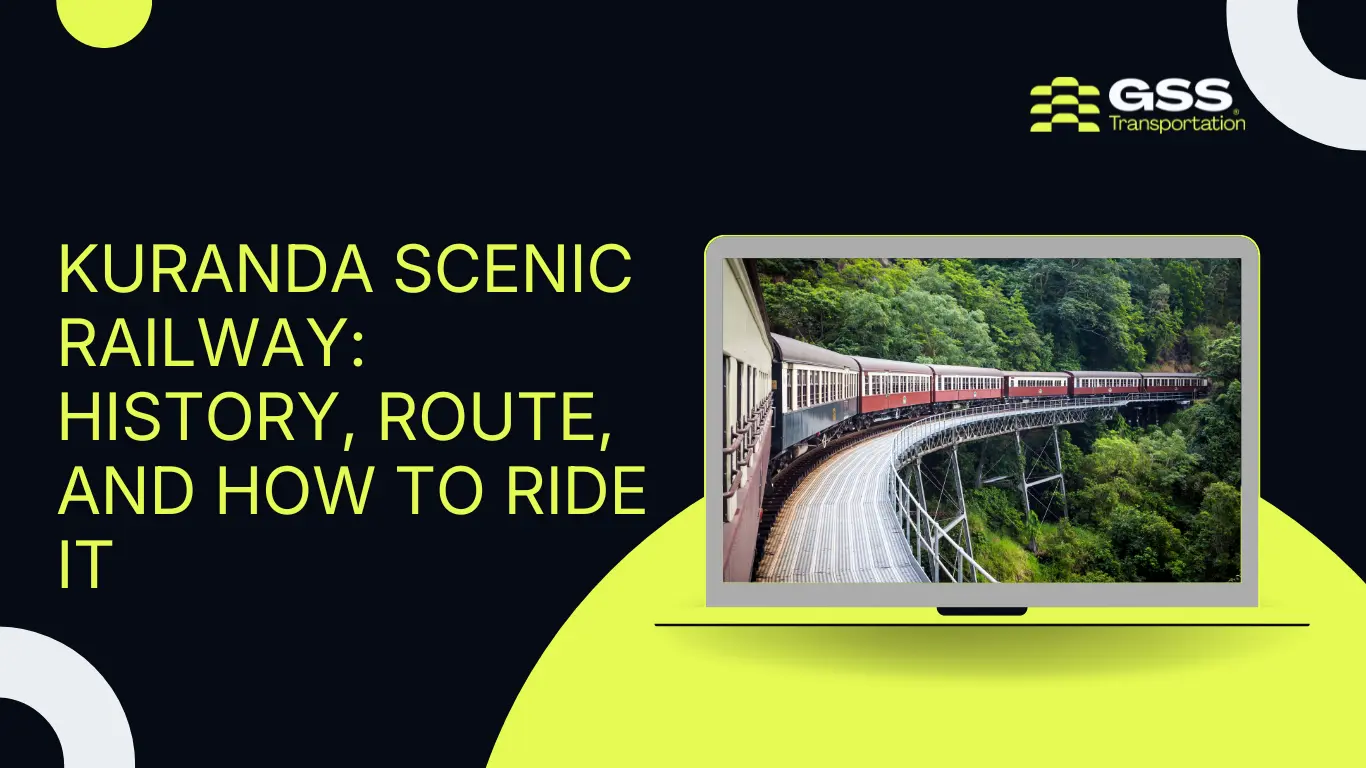
Workers cut the line to Kuranda between 1882 and 1891 using little more than picks, shovels, and explosives, carving 15 tunnels through solid rock and building dozens of bridges across a gorge that most engineers of the day considered close to impossible. On 25 June 2026, the railway marked 135 years since that first passenger journey. It was built to move ore and supplies to and from the Atherton Tablelands, not to entertain tourists, and it stayed a working line for decades before its true value became obvious: it’s one of the most spectacular short train journeys in the world, and it still runs almost exactly the route those original workers blasted through the mountain.
What the Journey Actually Involves
The train covers 37 kilometres between Cairns and Kuranda, climbing from sea level to 328 metres above it. According to the Kuranda Scenic Railway’s official route information, the full one-way journey takes somewhere between 1 hour 45 minutes and 2 hours, and it passes through Barron Gorge National Park, part of the World Heritage-listed Wet Tropics, with the carriages winding along cliff edges, through hand-carved tunnels, and across bridges that look almost fragile against the scale of the gorge below.
The undisputed highlight is the stop at Barron Falls Station, where the train pauses for around 10 minutes so passengers can walk out to a lookout over Barron Falls itself, a dramatic tiered waterfall that looks completely different depending on how much rain has fallen recently. Along the way, an onboard commentary (available in multiple languages, with a printed companion guide included) covers the history of the railway’s construction and the landscape you’re passing through, so the two hours never feel like dead travel time between two points.
Heritage Class vs Gold Class
There are two ways to make the trip. Heritage Class is the classic version: timber carriages, bench-style seating, and large open windows, largely unchanged in spirit from the original passenger cars, complete with water coolers and chilled towels on board. Gold Class is the upgraded option, available on select morning and afternoon departures only, with lounge-style seating, a dedicated host, and a more polished, personalised experience for those wanting a bit more comfort layered onto the same historic route.
Both classes travel the same track and stop at the same Barron Falls lookout, so the choice comes down to how much you want to spend on the experience around the journey rather than the journey itself.
Where the Train Actually Leaves From
This trips up more visitors than almost anything else about the railway. Departures run from two different stations depending on the time: Cairns Railway Station, in the city centre, and Freshwater Railway Station, a short distance out of town, with morning departures scheduled from both. If you’re self-driving or arranging your own transport to the station, it’s worth checking your specific ticket carefully rather than assuming Cairns Railway Station is automatically your departure point.
The return journey from Kuranda runs in the afternoon, generally departing sometime between 2pm and 3:30pm, back to Freshwater or Cairns depending on the service.
Combining It With Skyrail
Most visitors don’t ride the train both ways. The classic combination is riding the Skyrail Rainforest Cableway one way, gliding above the rainforest canopy with stops at Barron Falls and Red Peak, and taking the Scenic Railway the other way, giving you both the aerial perspective and the ground-level heritage journey in the same day without repeating either experience. Since Skyrail departs from Smithfield rather than the railway stations, combo tickets typically build in the short transfer between the two terminals, which is worth confirming when booking rather than assuming it’s automatic.
What’s Actually in Kuranda Once You Arrive
Kuranda Railway Station itself is worth a slow look before heading into the village; it’s known for its lush tropical gardens and has been called one of the most photographed railway stations in the world. From there, the village offers the well-known Kuranda Markets, along with wildlife attractions including the Australian Butterfly Sanctuary, Birdworld Kuranda, and Kuranda Koala Gardens, plus cafés and galleries scattered through the rainforest-fringed streets. Most visitors spend two to four hours in the village between arriving on the train (or Skyrail) and heading back.
Best Time to Ride
The railway operates daily year-round, but the experience shifts noticeably with the seasons. Dry season, roughly May to October, brings clearer views and more comfortable travelling weather, and it’s also the busiest period, so booking ahead matters more during these months. Wet season, November to April, brings a lusher rainforest and noticeably stronger waterfalls at the Barron Falls stop, at the cost of a higher chance of a shower during the village stopover. Neither season is a wrong choice; it depends on whether you’d rather have guaranteed clear skies or a more dramatic, fuller waterfall.
Worth knowing ahead of any trip: both the Scenic Railway and Skyrail schedule periodic maintenance closures, so it’s worth checking current operating dates directly with the railway close to your travel dates rather than assuming it runs every single day without exception.
An Engineering Story Worth Knowing
The line’s construction is genuinely one of the more remarkable feats of colonial-era engineering in Australia. Workers had no modern machinery, working instead with hand tools and dynamite along a route that climbs the near-vertical face of the Barron Gorge, and the human cost was real, with a number of workers losing their lives during the nine years of construction. The line was recognised by Engineers Australia as a National Engineering Landmark, a rare distinction that reflects both the difficulty of the original build and how well the route has been maintained across more than a century of continuous operation. Today the same fifteen hand-carved tunnels and dozens of the original bridges are still in use, meaning every passenger riding through them is travelling the exact path blasted out by hand well over a hundred years ago.
The railway wasn’t originally built with tourism in mind at all. Its first purpose was moving tin ore, timber, and supplies between the coast and the Atherton Tablelands, at a time when the alternative was a long, difficult overland route through the same rainforest terrain. It operated as a working commuter and freight line for decades before its scenic value was properly recognised, with tourist services beginning as early as the 1930s alongside its ongoing freight role, and it has run purely as a tourist and heritage attraction since. That dual history, functional infrastructure first, scenic drawcard second, is part of what makes the journey feel different from a purpose-built tourist railway: the route exists because it had to, not because someone designed the prettiest possible line.
Barron Gorge Beyond the Train Window
The gorge the railway winds through does more than provide scenery. Barron Falls and the surrounding Barron Gorge National Park sit within the broader Barron River catchment, which also feeds a hydroelectric power station further down the gorge, one of the reasons the falls themselves can look dramatically different depending on water flow management as well as rainfall. On a high-flow day, particularly during or just after wet season, the falls at the train’s photo stop are considerably more powerful than during a dry-season visit, when flow is naturally lower and, depending on operational needs, sometimes further reduced. Neither version is the “wrong” one to see, but it’s worth knowing why the same waterfall can look so different between two visits.
A Few Practical Tips
- Take a window seat if you can choose one; the clearest views of the gorge, waterfalls, and heritage bridges are all on one side of the carriage for most of the journey.
- Arrive 20 to 30 minutes before departure to collect tickets, get settled, and take a look around the heritage station itself before boarding.
- Pack light rain protection if travelling during the wetter months, since showers are common between November and April both on the train and while exploring the village.
- Have a camera ready for the Barron Falls stop and the Stoney Creek Bridge crossing, both consistently the most photographed moments of the trip.
Getting to the Station
Self-driving or a taxi works well if you’re staying in central Cairns, given how close Cairns Railway Station sits to the city centre. Guided combo tours commonly include hotel pickup from Cairns, Palm Cove, or Port Douglas, bundling the transfer, both the train and Skyrail, and sometimes a wildlife park visit into a single full day. Private transfer suits travellers who’d rather arrive at their own pace, particularly those departing from Freshwater Station or needing to be at the platform for a specific departure time rather than a group tour’s schedule.
Book Your Transfer
- Cairns Airport to Kuranda, direct transfer if Kuranda itself is your destination for the day
- Cairns Airport to City, for departures from Cairns Railway Station
- Full Price List, all routes and vehicle types
For how a Kuranda day fits alongside the region’s other big experiences, see our guide to Cairns in 3 Days.
Common Questions About the Kuranda Scenic Railway
The one-way trip takes roughly 1 hour 45 minutes to 2 hours, covering 37 kilometres between Cairns and Kuranda, including a 10-minute stop at Barron Falls.
Departures run from Cairns Railway Station in the city centre and Freshwater Railway Station a short distance out of town, with morning services scheduled from both. Check your specific ticket for the correct departure point.
Heritage Class is the classic timber-carriage experience with bench seating and large windows. Gold Class, available on select departures only, adds lounge-style seating, a dedicated host, and a more premium service on the same route.
Most visitors combine the two, riding Skyrail one way for the aerial rainforest view and the Scenic Railway the other way for the heritage train experience, rather than repeating the same journey twice.
Construction ran from 1882 to 1891, and the railway marks 135 years of passenger service as of 25 June 2026, making it one of the oldest continuously operating scenic railways in Australia.
Dry season, roughly May to October, offers the clearest views and is the busiest period, so booking ahead is worthwhile. Wet season, November to April, brings a greener rainforest and stronger waterfalls at the Barron Falls stop, with a higher chance of rain during the village stopover.
It operates daily year-round, though both the railway and Skyrail schedule periodic maintenance closures. It's worth checking current operating dates directly with the railway close to your travel dates.