
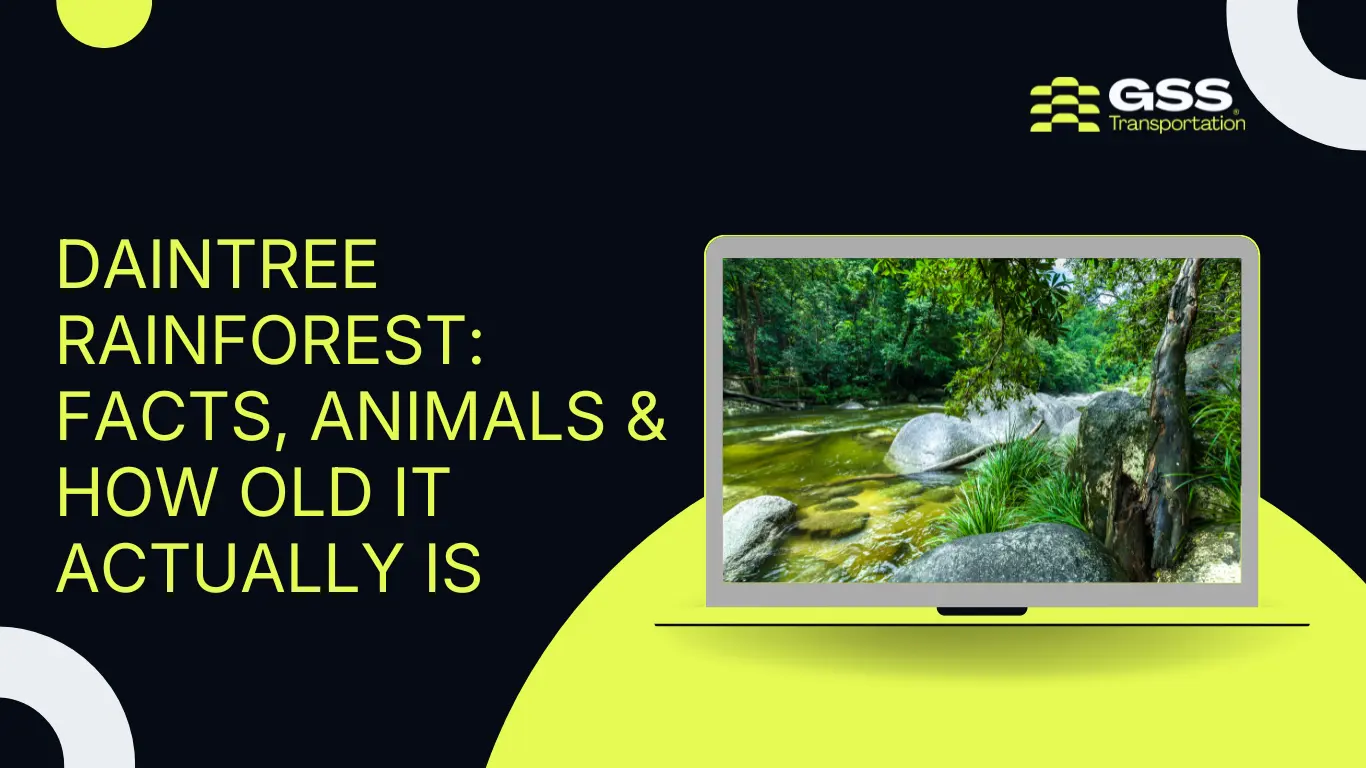
The Daintree gets called “the world’s oldest rainforest” so often that the phrase has become background noise, repeated on brochures and blog posts without much explanation of what it actually means or why it’s true. This guide covers the real substance behind the claim: how old the Daintree actually is, what makes its wildlife so unusual, how it compares to the Amazon, and what you’re likely to see if you visit.
How Old Is the Daintree Rainforest, Really?
The Daintree is widely regarded as the oldest continuously surviving tropical rainforest on Earth, with plant lineages tracing back somewhere in the order of 100 to 180 million years, depending on which specific dating method and plant group is being referenced. The figure most commonly cited by tourism and conservation sources sits around 180 million years, based on the age of plant family lineages present across the Wet Tropics bioregion, which would place its origins close to the early breakup of the supercontinent Gondwana.
What isn’t in dispute is the comparison that actually matters: the Daintree is substantially older than the Amazon, which took its current form roughly 55 million years ago, and older than Malaysia’s Taman Negara rainforest, often cited as the next-oldest on record. Where the Amazon has been through repeated cycles of contraction and regrowth as the climate shifted, the Wet Tropics’ mountainous terrain trapped enough consistent moisture that the Daintree never fully dried out or disappeared, even through past ice ages. That unbroken continuity, rather than the exact number of millions of years, is really what “oldest rainforest” is describing.
Where It Sits and How Big It Is
The Daintree lowland rainforest covers roughly 1,200 square kilometres, making it the largest single contiguous block of rainforest in Australia. It forms part of the much larger Wet Tropics of Queensland World Heritage Area, an 8,944-square-kilometre listing that stretches around 450 kilometres from Cooktown to Townsville and was inscribed by UNESCO in 1988 for its outstanding universal value as a living record of the evolutionary history of land plants.
The core visitor experience sits within Daintree National Park, officially Daintree National Park (CYPAL), which is jointly managed by the Jabalbina Yalanji Aboriginal Corporation and Queensland Parks and Wildlife Service under an Indigenous Management Agreement. The park has two distinct sections. Mossman Gorge, in the south, covers around 56,500 hectares of largely inaccessible rainforest and mountain woodland, where the Mossman River cascades over granite boulders. Cape Tribulation, further north across the Daintree River, is where rainforest-clad mountains run straight down to sandy beaches, putting two World Heritage Areas, the Wet Tropics and the Great Barrier Reef, side by side in a way found almost nowhere else on the planet.
The Eastern Kuku Yalanji Connection
The Eastern Kuku Yalanji people are the Traditional Owners of Daintree National Park (CYPAL), with a connection to this Country that extends back tens of thousands of years, well before European settlement in the late 1800s. That connection isn’t historical trivia, it’s built into how the park is actually run today, through joint management arrangements between the Jabalbina Yalanji Aboriginal Corporation and Queensland Parks and Wildlife Service. Cultural tours, including guided walks through Mossman Gorge led by Kuku Yalanji guides, offer a way to understand the rainforest through language and knowledge developed over an extraordinarily long relationship with this specific landscape.
The Animals That Make the Daintree Unusual
The Daintree’s age and isolation are the reason its wildlife looks the way it does. Species had an enormous amount of uninterrupted time to specialise, and the result is a level of endemism, species found nowhere else, that’s out of proportion to the size of the area.
Southern cassowary. The Daintree region is one of the cassowary’s key remaining strongholds, and the bird plays an outsized ecological role as one of the few animals capable of dispersing the large seeds of certain rainforest fruit trees. The Wet Tropics population is listed as endangered under both Commonwealth and Queensland law, and in the Daintree specifically, roads cutting through cassowary home ranges are a recognised hazard, which is why speed limits and cassowary crossing signage are taken seriously on the drive north of the ferry.
Tree kangaroos. Bennett’s tree kangaroo occurs in the Daintree and surrounding Cape York-adjacent ranges, one of only two tree kangaroo species found in Australia. Spotting one takes patience, they favour the upper canopy and are most active at dawn and dusk, but guided night walks in the area are built specifically around this kind of sighting.
Boyd’s forest dragon. A large, spiny, well-camouflaged lizard found in the Daintree and Mossman Gorge in particular, Boyd’s forest dragon perches motionless on tree trunks and vines and is easy to miss unless you’re deliberately scanning the mid-storey rather than just the trail ahead of you.
Estuarine (saltwater) crocodiles. The Daintree River is genuine crocodile habitat, and this is one of the more reliable places in Australia to see a wild saltwater crocodile from a guided river cruise. It’s also a serious safety consideration for anyone tempted to swim in the river itself, which QPWS advises against for exactly this reason.
Birdlife. Victoria’s riflebird, a bird-of-paradise relative known for an elaborate courtship display, is found in the Mossman Gorge section, alongside a wider bird community that makes up a meaningful share of Australia’s total recorded species despite the Daintree covering only a tiny fraction of the country’s land area.
Beyond the headline species, the numbers speak for themselves. Estimates commonly cited for the Wet Tropics as a whole put roughly 30 percent of Australia’s frog species, 40 percent of its bird species, over a third of its mammal species, and around 65 percent of its butterfly and bat species within this comparatively small area, alongside thousands of recorded insect species.
How to Get There and Get Around
From Cairns, the Daintree is roughly a two-hour drive north along the Captain Cook Highway, or around 45 minutes from Port Douglas. For the Mossman Gorge section, visitors typically park at the Mossman Gorge Centre and take a short shuttle bus into the park itself, since private vehicle access into the gorge is restricted; walking or cycling in is also possible free of charge at any time.
To reach Cape Tribulation, you’ll cross the Daintree River on the vehicle ferry, which operates from 5am to midnight daily with reduced service on Christmas Day and occasional closures for mechanical work or flooding. Beyond the ferry, the road is accessible to conventional two-wheel-drive vehicles, though high clearance is genuinely useful given the terrain, and caravans aren’t recommended. This is also the point where a Cairns or Port Douglas day tour or private transfer becomes a practical alternative to self-driving, particularly for visitors who’d rather not manage ferry timing and narrow rainforest roads themselves on top of a full day of sightseeing.
Practical Things to Know Before You Go
- The wet season affects access. Noah Beach camping area in the Cape Tribulation section closes every year from the first Sunday after New Year’s Day through to Good Friday, and roads can be affected by heavy rain outside that window too. Check current park alerts before travelling.
- Fishing rules vary by location. Fishing is permitted in most tidal creeks around Cape Tribulation but prohibited in Cooper Creek and in the Mossman River and non-tidal creeks throughout the park.
- Marine stingers and crocodiles are both real risks in season. Dangerous jellyfish can be present in coastal waters year-round but more frequently in warmer months, and “croc wise” behaviour around any tidal waterway, including the Daintree River itself, is standard advice rather than an overcautious warning.
- Mobile reception is patchy to non-existent through much of the Cape Tribulation section, so plan accordingly if you’re relying on your phone for navigation or emergencies.
Daintree vs Amazon: A Quick Comparison
It’s a common question, and worth answering directly. The Amazon is vastly larger in total area and holds more species in absolute terms, simply because of its size. But the Daintree’s plant lineages are dramatically older, by most estimates well over 100 million years older, and its continuity is unusual: it survived past ice ages largely intact rather than contracting and re-expanding the way the Amazon has. In other words, the Amazon wins on scale, but the Daintree wins on evolutionary depth, which is really what the “oldest rainforest” title is about.
Final Thoughts
The Daintree earns its reputation, but the interesting part isn’t really the number of millions of years attached to it, it’s what that unbroken span of time produced: a concentration of ancient plant lineages and highly specialised, often endangered wildlife found nowhere else on the planet, managed today in partnership with the people who have known this Country the longest. Whether you’re planning a Mossman Gorge walk, a Cape Tribulation beach day, or a full Daintree River cruise, understanding what you’re actually looking at makes the drive north from Cairns a genuinely different kind of day trip than the coastal and Tablelands options closer to town.